


Bosch Auto Parts: From a Small Workshop to a Global Automotive Leader
Introduction
Few names in the automotive industry command the same level of trust and recognition as Bosch. For more than a century, Bosch has played a major role in shaping the development of modern vehicles through continuous innovation in ignition systems, electrical components, safety technologies, fuel management, and automotive electronics. What began as a small workshop in Germany has evolved into one of the world’s largest automotive technology suppliers, with Bosch auto parts found in passenger cars, trucks, agricultural machinery, industrial equipment, and electric vehicles across the globe. [bosch.com], [bosch.com]
The Beginning: Robert Bosch’s Vision
The story of Bosch started on November 15, 1886, when German engineer Robert Bosch founded the “Workshop for Precision Mechanics and Electrical Engineering” in Stuttgart, Germany. Initially, the business focused on electrical installations, telephone systems, and precision mechanical work for local customers. [bosch.com], [bosch.com]
Robert Bosch was known for his commitment to quality, innovation, and customer satisfaction. His famous principle, often summarized as “It’s better to lose money than trust,” became a cornerstone of the company’s culture and helped establish Bosch’s reputation for reliability.
During its early years, the workshop faced many challenges, but Bosch’s ability to improve existing technologies soon set the company apart from competitors. [bosch.com], [assets.bosch.com]
The Automotive Breakthrough
Bosch’s transformation into an automotive company began in the late 1890s.
In 1897, Bosch engineers adapted and improved the magneto ignition system for use in automobiles. At a time when early vehicles suffered from unreliable ignition technology, Bosch’s design proved dependable and effective. This breakthrough made Bosch the leading supplier of ignition systems for the growing automobile industry. [bosch.com], [boschautoservice.com]
An even greater milestone followed in 1902 when Bosch chief engineer Gottlob Honold developed the high-voltage magneto ignition system with spark plug. This invention dramatically improved engine reliability and efficiency and laid the foundation for the modern gasoline engine. The spark plug remains one of Bosch’s most iconic automotive products to this day. [bosch.com], [boschautoservice.com]
Expansion and Global Growth
As automobile production increased during the early twentieth century, Bosch expanded rapidly.
By the early 1900s, the company had established international sales offices and opened larger manufacturing facilities. Before World War I, a significant share of Bosch’s business came from international markets, demonstrating the company’s early global reach. [bosch.com], [en.wikipedia.org]
Bosch entered the United States in the early 1910s and continued expanding throughout Europe, Asia, and South America. Its ignition technology became standard equipment in many vehicles worldwide. [boschautoservice.com], [en.wikipedia.org]
Despite disruptions caused by two world wars, economic instability, and changing market conditions, Bosch rebuilt and strengthened its international operations, emerging as a leading global automotive supplier in the post-war era. [bosch.com], [en.wikipedia.org]
Innovation Through the Twentieth Century
Bosch’s influence on automotive technology expanded dramatically throughout the twentieth century.
Diesel Fuel Injection
In 1927, Bosch introduced the first mass-produced diesel injection pumps and injectors, helping diesel engines become more efficient, reliable, and practical for commercial vehicles. [boschautoservice.com]
Windshield Wipers
In 1926, Bosch launched an electrically powered windshield wiper system, significantly improving driver visibility and safety in poor weather conditions. [boschautoservice.com]
Fuel Injection Technology
During the 1950s and 1960s, Bosch pioneered advancements in fuel injection systems. These technologies provided better fuel economy, increased power, and lower emissions compared to traditional carburetor systems. [boschautoservice.com]
Electronic Engine Management
The launch of Jetronic electronic fuel injection in 1967 marked a major shift toward electronic engine control systems. This innovation became the foundation for many modern engine management technologies. [boschautoservice.com]
Emissions Control
In 1976, Bosch developed the Lambda (oxygen) sensor, allowing precise fuel control and helping automakers meet increasingly strict emissions regulations around the world. [boschautoservice.com]
Anti-lock Braking Systems (ABS)
One of Bosch’s most significant contributions to vehicle safety came in 1978 with the introduction of practical Anti-lock Braking Systems (ABS). ABS transformed vehicle control during emergency braking and became a standard safety feature in modern automobiles. [boschautoservice.com]
Bosch Auto Parts Today
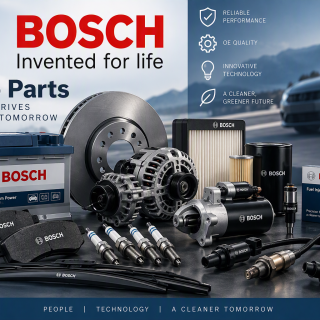
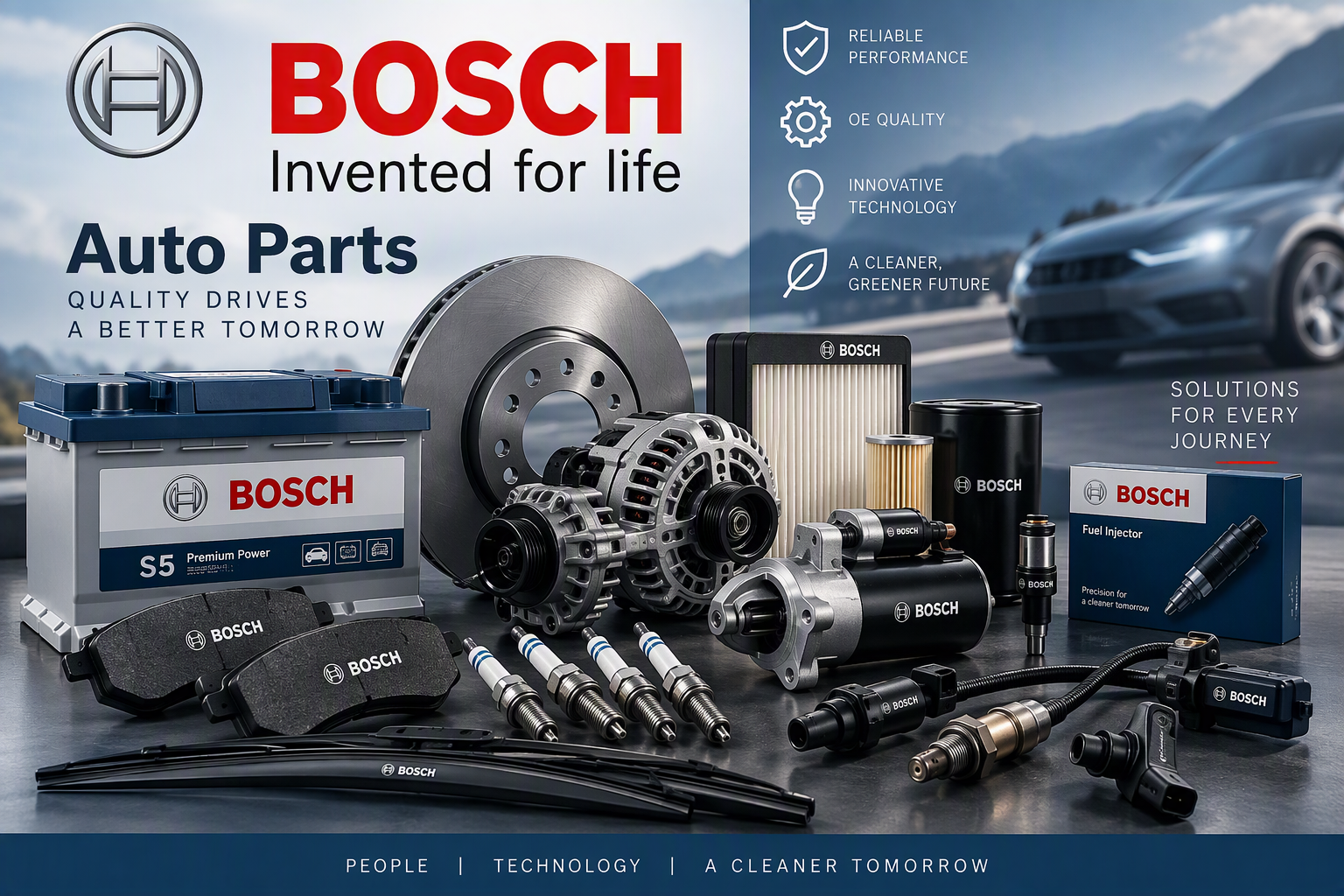
Today, Bosch is one of the world’s largest automotive suppliers, producing an extensive range of replacement and original-equipment (OE) components. Many vehicle manufacturers rely on Bosch technologies during production, while consumers and repair workshops rely on Bosch replacement parts for maintenance and repairs. [bosch.com], [en.wikipedia.org]
Key Bosch auto parts include:
- Alternators
- Starter motors
- Spark plugs
- Ignition coils
- Fuel injectors
- Fuel pumps
- Oxygen sensors
- Brake components
- Batteries
- Wiper blades
- Cabin and engine air filters
- Engine management sensors
- Electronic control systems
- Diesel injection systems [boschautoservice.com], [en.wikipedia.org]
Bosch’s reputation in the aftermarket industry stems from its strong focus on OE-quality manufacturing, engineering precision, and rigorous testing standards.
Bosch and the Future of Mobility
As the automotive industry transitions toward electrification, connectivity, and automation, Bosch continues to invest heavily in research and development.
The company is actively involved in:
- Electric vehicle powertrain technologies
- Advanced driver assistance systems (ADAS)
- Automated driving solutions
- Vehicle connectivity
- Digital diagnostics
- Hydrogen technologies
- Smart mobility services [bosch.com], [en.wikipedia.org]
Rather than focusing solely on traditional components, Bosch has evolved into a technology provider supporting the future of transportation. Its expertise in electronics, software, sensors, and vehicle systems positions the company to remain a major influence in the automotive sector for decades to come.
Conclusion
The history of Bosch Auto Parts is a story of innovation, resilience, and engineering excellence. From Robert Bosch’s small workshop in Stuttgart in 1886 to today’s global technology powerhouse, the company has consistently shaped the evolution of the automobile. Through pioneering advancements such as the spark plug, fuel injection systems, oxygen sensors, ABS brakes, and modern automotive electronics, Bosch has helped define how vehicles perform, operate, and keep passengers safe.
More than 140 years after its founding, Bosch remains one of the most respected names in the automotive industry, continuing to supply high-quality auto parts and develop technologies that will drive the next generation of mobility. [bosch.com], [en.wikipedia.org]
Store Updates

Know Us

Product Showcase